


Silver
Creativity In Media
Use of Digital, Social and Gaming Platforms


| Entrant: | Leo Singapore, Singapore |
| Brand: | Vaseline |
| Title: | "Vaseline and The Real Nigerian Prince" |
| Region or Country Where Released: | Nigeria |
| Corporate Name of Client: | Unilever International |
| Client Company: | Unilever International, Singapore |
| Client Head of Brand Marketing: | Shazan Zahir |
| Client Company Head of Sales Africa: | Anirban Mullick |
| Client Company Business Development Manager/Nigeria: | Ibidare Adegunle |
| Client Company Assistant Brand Manager: | Xingyun Tan |
| Client Company Marketing Assistant: | Janson Tan |
| Media Company: | All Seasons Zenith, Lagos |
| PR Company General Manager: | Alicia Thong |
| Media Buyer: | David Okutuo |
| PR Companies: | MSL Singapore, Singapore/Persuasion Communications, London/Quadrant MSL, Lagos |
| Agency: | Leo Singapore, Singapore |
| Agency CEO: | Joanne Theseira |
| Agency Chief Creative Officer: | Ajay Vikram |
| Agency Executive Creative Director: | Asheen Naidu |
| Agency Group Creative Director: | Sergey Mast |
| Agency Creative Director - Copy: | Boston Ho |
| Agency Creative Director - Art: | Eugene Yow |
| Agency Director of Integrated Production: | Bettina Feng |
| Agency Senior Integrated Producer: | Isabelle Lee |
| Agency Business Director: | Melissa Tee |
| Agency Planning Director: | Valerie Wang |
| Production Company: | AMA Psalmist Visuals, Lagos |
| Production Company Director: | Ibidunni Oladayo |
| Production Company 1st AD: | Fasunhan Oluwatosin |
| Production Company Producer: | Abraham Christiana |
| Production Company DoP: | Granville Wilson |
| Production Company Designer: | Chris Udomi |
| Production Company Head of Production: | Michael 'AMA Psalmist' Akinrogunde |
| Production Company Photographer: | Ryan Alabi |
| Post-Production Company: | Prodigious, Singapore |
| Color Company: | Mushroom Media, Lagos |
| Color Company Colorist: | Kyle Stroebel |
| Recording Studio: | FVSE, Singapore |
Cultural Context:
Nigeria has one of the most saturated media landscapes in Africa, and for big brands, media is easy to buy. But another billboard educating on counterfeits would turn into a blind spot.
So instead of buying traditional media, we bought a real Prince — and media space on his feed. His Instagram became our launch platform, earning organic reach that multiplied our limited spend.
Cultural Context
Vaseline is a household staple in Nigeria, bought from local market stalls and neighbourhood shops. Cocoa Radiant Body Oil became one of the most popular skincare products in the country — affordable, non-greasy, and delivering the radiance that sits at the heart of Nigerian skincare culture. Its ubiquity made it a perfect target for fakes.
Fakes cost the EU beauty industry an estimated €3 billion in lost sales annually, nearly 5% of the entire sector.
Beauty brands have responded with holographic stickers, updated packaging, and legal action — but counterfeiters copy faster than brands can update, and lawsuits take years. In Nigeria, where regulation is thinner and distribution is informal, the problem runs deeper.
By 2025, counterfeit Vaseline Body Oil had flooded Nigerian markets so thoroughly that real and fake were indistinguishable. Even trusted mom-and-pop stores were unknowingly selling counterfeits.
Vaseline had tried educating consumers with new labels, educational posts, KOLs. But as fakes grew more sophisticated, every guide became outdated almost immediately.
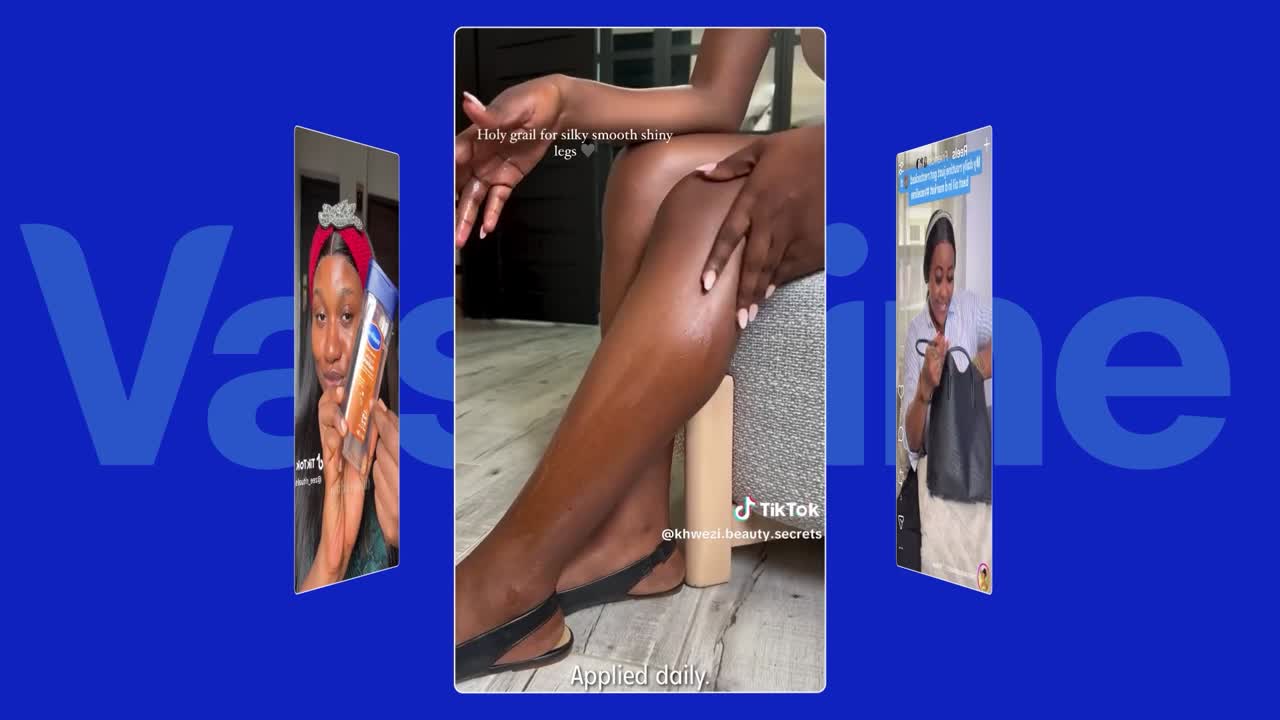
On Social, Nigerian consumers were filming side-by-side comparisons of bottles. Some of those videos, viewed millions of times, were unknowingly showcasing fakes as genuine.
The community trying to solve the problem had become part of the problem. Vaseline had a choice — respond the way every brand responds to fakes, or find another way to help consumers reliably authenticate when they need it.
We found both in an unlikely ally.
For 30 years, "Nigerian Prince" has been the internet's shorthand for a scam. But real Nigerian Princes exist, and their identities had been stolen by the same enemy as Vaseline's: scammers.
So we turned a shared enemy into a shared fight. Vaseline partnered with Prince Chris Okagbue, who used his platform to drive consumers to a WhatsApp-based Vaseline Authenticator — a tool that scans a product label and tells you instantly if it's real or fake.
The Prince earned the attention. WhatsApp, the app Nigerians already use every day, delivered the certainty. No app download, no new behaviour, no friction.
At the end of the campaign period…
The Prince drove belief: Reaching a total of 4.7mil organic views. The authenticity from the campaign and Prince turned our audiences into advocates, seeing a 106% engagement rate, 130,000 shares, and 13,800 reposts on our launch post alone.
Making them the campaign’s biggest distributors and performing 9x better than the best-performing macro KOL post on @VaselineNigeria. All organic, zero paid amplification.
The tool delivered proof: For the first time, Vaseline had real-time visibility into the scale of counterfeiting in Nigeria. 10,808 interactions on the Authenticator App and 7 in 10 bottles scanned were fake. That's 7 in 10 users spared from untested ingredients.
The idea paid back: On a topic most brands consider too risky to touch, 94% of comments were positive. A $14,500 investment generated $401,293 in earned engagement value, that’s a 26x return. And what started in Nigeria didn't stay there with the campaign earning coverage across 96 global and local titles.
The Vaseline Authenticator uses Google Vision API to analyse product labels submitted by consumers via WhatsApp. The API extracts information on labels to determine whether a product is genuine or counterfeit.
All inputs are consumer-submitted photographs. The AI serves as a detection layer within the verification tool — it does not generate creative content.
In the entry materials: AI-assisted voice-over was used in the case study film. All other campaign materials and entry materials, unless otherwise stated, are human-created.