


Gold
Production & Post
Cinematography
| Entrant: | Synthesis Agency, Tashkent |
| Brand: | National Agency for Social Protection |
| Title: | "Under the President of the Republic of Uzbekistan" |
| Region or Country Where Released: | Uzbekistan |
| Corporate Name of Client: | National Agency for Social Protection under the President of the Republic of Uzbekistan |
| Client Company: | National Agency for Social Protection under the President of the Republic of Uzbekistan, Tashkent |
| Client CEO: | Mansurbek Polvonzoda Olloyorov |
| Client President: | Shakhnoza Shavkatovna Mirziyoyeva |
| Client Head of Brand Marketing: | Ruzmetova Dilfuza |
| Agency: | Synthesis Agency, Tashkent |
| Agency CEO: | Alina Mirzaeva |
| Agency Creative Directors: | Farrukh Sharif/Zamira Rakhmanova/Denis Eliseev/Andrey Gubaidullin |
| Agency Senior Copywriters: | Sergey Gorobtsov/Shohruh Jamoliddinov/Shakhzod Khaydarov |
| Agency Designers: | Vlada Idunova/Sabrina Akrami |
| Agency Account Managers: | Yuliya Gerasimova/Darya Gerasimova/Valeriya Shamakova/Anna Kim |
| Production Company: | Khabi Media, Tashkent |
| Production Company CEO: | Khabibullo Nabiev |
| Production Company Director: | Lado Kvataniya |
| Production Company 1st AD: | Nikita Mironov |
| Production Company 2nd AD: | Akmal Mukhitdinov |
| Production Companies Producer(s): | Nelya Akhmedova/Kamoliddin Xamraev |
| Production Company DoP: | Vladimir Ushakov |
| Production Companies Designer(s): | Alexey Yandovskiy/Maria Gracheva/Victoria Radionova |
| Casting Company: | Khabi Media, Tashkent |
| Casting Agent: | Bakhtiyar Raimzhonov |
Cultural Context:
Children are often seen not as independent individuals, but as objects of adult authority and control. As a result, abuse frequently remains invisible — socially tolerated and historically weakly addressed by law.
In 2024, this systemic issue became especially visible when a case of repeated sexual abuse of a child nearly resulted in a lenient sentence. The moment revealed a gap between the reality children live in and how society and institutions respond.
The Agency initiated Weight of Pain as a multi-layered public project designed to break this silence. Film was chosen as its central element — a starting point that could emotionally engage audiences and introduce a shared symbol.
From there, the project expanded into cinemas, exhibitions, media discussion, and public forums.
Created for this market and moment, the film allowed the Agency to move beyond policy communication and enter the cultural space, using cinema to frame a national issue in a way that could be understood, discussed, and carried forward through the wider project
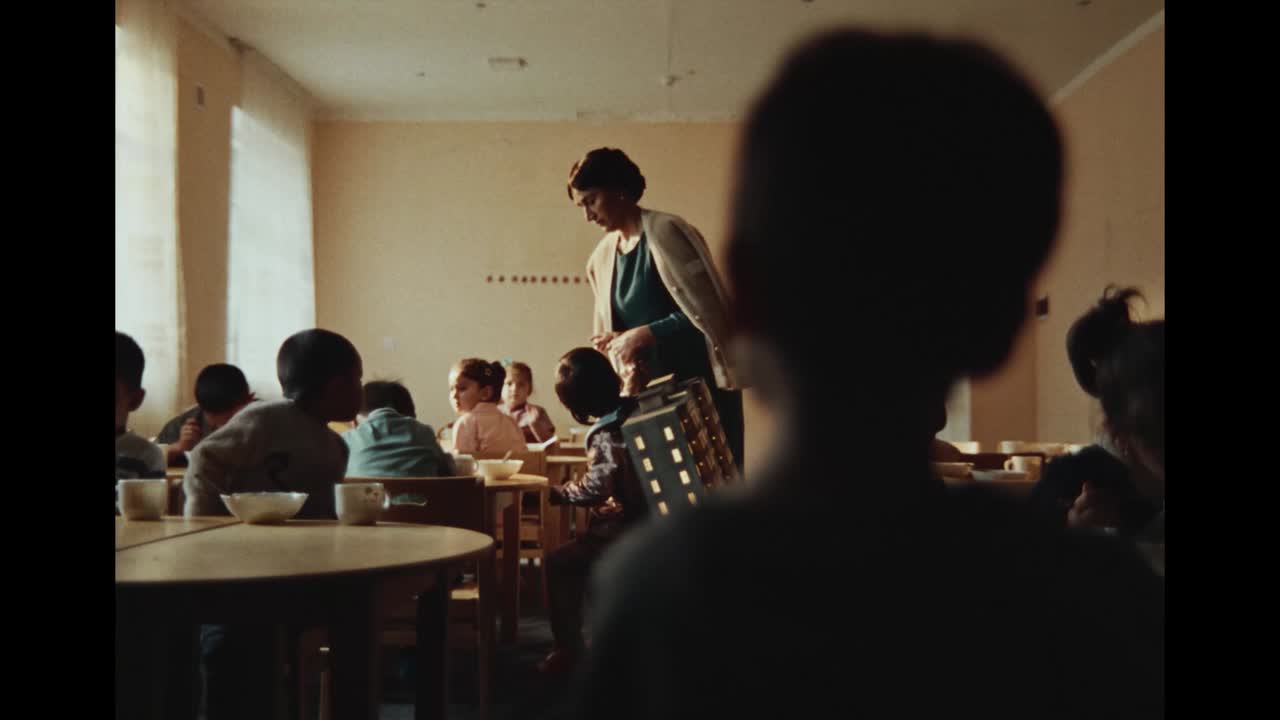
Each child carries a heavy backpack shaped like the building they come from. The weight is constant and visible, pressing on their bodies as they walk, sit, and stand in silence.
At night, light appears inside the backpacks. Through projections, shadows, and fragments of real events, the film reveals memories of violence connected to these places.
The buildings become containers of pain — trauma carried from spaces where children were meant to be safe.
As the stories unfold in parallel, the weight grows heavier. In the final sequence, the children are joined by others in public spaces, each holding similar building-shaped backpacks.
The image expands from individual stories to a shared reality, leaving the weight unresolved and present beyond the screen
The project was covered by more than 150 media outlets and reached over 24 million people. The conversation extended into cinemas, exhibitions, public events, and a UNICEF conference in Uzbekistan, where a child publicly spoke out against violence.
This sustained public attention contributed to institutional change. Uzbekistan’s parliament adopted a stricter version of the law “On the Protection of Children from All Forms of Violence,” and the film became mandatory viewing for professionals working with children.
Most importantly, a man who had previously avoided serious punishment for the sexual abuse of his stepdaughter was sentenced to 17 years in prison — the first case of such a severe sentence in the country.
The project demonstrated how film, embedded within a wider initiative, can help drive real cultural and legal change